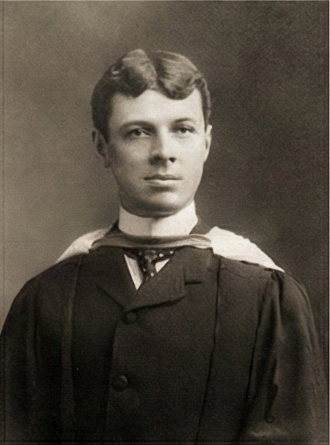
Chapter 5 - George Burr and Jennie Black
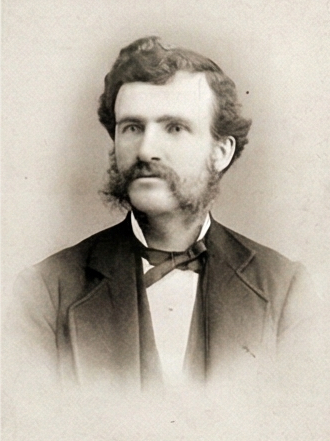
George Burr was born in 1854. He was the sixth child of Alexander and Isabella Burr. His father had come to Canada in 1835, at the age of 18, and his mother three years later, in 1838. It would appear that Alexander and Isabella were married the same year, when they were both twenty-one.
Alexander and Isabella’s first daughter, Christian, was born in about 1839. In all, they had seven children, as follows (based on the 1851 census):
- Christina, a daughter, born about 1842;
- Andrew, born about 1845;
- Alexander, born about 1846;
- James, born about 1848;
- William, born about 1851;
- George, born 1854.
Alexander Burr purchased the family farm (the south and the north 1/2 of 100 acres of Lot 5, Concession 5, West Garafraxa) from the Canada Company September 19, 1845 (registered May 29, 1848, as Instr. 484, Book H6). Why the property was conveyed to Alex Burr, Jr., in trust is unknown. Assuming that Alexander Burr is the person named in the 1861 census as being 14 years of age, he would’ve been thirty-eight, at the time of the conveyance.
The 1851 census records that the Burr household consisted of five children, a daughter and four sons, presumably, George’s brothers and sisters at the time of his birth three years later. Based on their ages at the time of the census, their ages, when George was born, (1854) were as follows:
- A sister, Christina, age 12
- Andrew, age 10
- Alexander, age 8
- James, age 6
- William, 3 years old.
In 1851, the census records that the family resided in a log cabin. In 1834, 25 percent of homes in Upper Canada were of this type. Many Irish settlers built log shanties similar to the wooden and clay huts they had back home. They had high earth embankments up against the walls, were low, and looked like caves on a hillside. Wealthy settler Samuel Strickland’s log house at Pigeon Lake, Peterborough County, was American-style, made of “elm-logs, 36 feet long by 24 feet wide, …divided into three rooms on the ground floor, besides an entrance hall and staircase and three bedrooms upstairs”.
Although none of the Burr children are recorded as attending school in this census, (they are in the next census, ten years later), it is still likely that they were attending school in 1851. The Common School Acts had been passed in Upper Canada in 1816 to regulate the establishment of grammar schools, and provided for the construction of the schoolhouse in the employment of a teacher for six months if there were 20 students available.
The photograph taken of the Burr family, apparently taken in 1855, shows Alexander and Isabella, both at 37 years of age, and six children. Their youngest child, George, appears to be about a year old. In 1855, the daughter, Christina, was 13, Andrew was 11, Alexander 9, James 7, William 4 and George 1.
By 1861, Christina was 22 and Andrew 20. Both had probably formed household of their own (Christina married Robert Allan). Thus, in the census for that year (p. 21 for the Township of Garafraxa) the following members of the Burr household are recorded, seven years after George’s birth:
- Alixe Burr, a male, who was 14 years old. On his last birthday.
- James Burr, who was 12,
- William Burr, who was 10,
- George Burr, who was 7, and
- Isabell, who was 0 on her last birthday.
All of the Burr children are showing his members of the Three Church and born in Canada. All but Isabell are shown as attending school within the year. No deaths are recorded in the previous year and no type of house is record.
The census for 1871 (p. 14 for Division I, Garafraxa W.) records that George, then a 17-year-old farmer, is residing with his parents, his older brother, William, then 20 years old, and his 16-year-old sister, Isabella. His older brother Andrew, age 27, had married a woman named Margaret, then 21, would been born in Scotland. They had established their own home and had a one-year-old daughter, Isabella, born in Ontario.
None of the Burrs is shown as attending school in 1871, but none is recorded as unable to read or write.
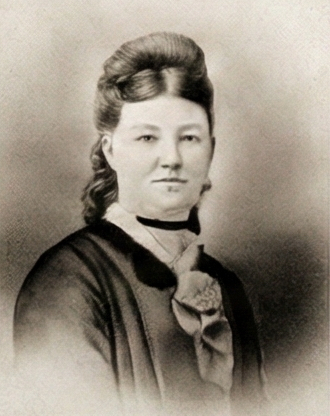
On February 1, 1877, George Burr, at the age of 23, married Jennie Black (According to the Burr Family Bible that George gave to his second wife, Margaret, Alexander, on July 11, 1890).
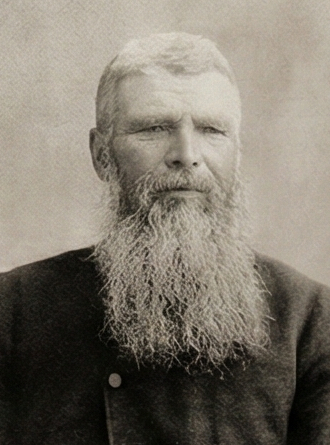
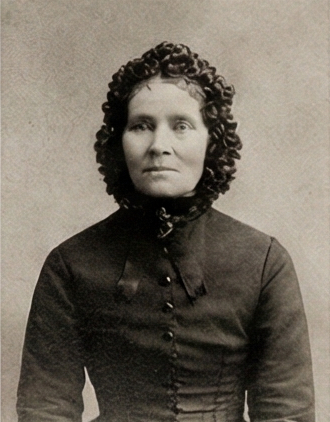
Jenny (Jennet) Black was the daughter of David John Black and his first wife, Joan, Alexander. (, According to research on file at the Wellington County Museum, done by Mrs. T. J. Hutchinson, of Fergus. In March, 1981, and donated by Miss L. Black of 196 Glengarry Avenue, Toronto, David J. Black was the son of William Black, who was born in March 1802 (died April 3, 1858) and came from County Antrim, Ireland, in 1822; his wife, Agnes McCune, was born on July 1, 1799 (died January 13, 1891) and came from County Fyfe, Scotland.
Antrim is the former county in Ulster Province in Northern Ireland. Belfast was the county town. Antrim comprised a hilly region on the north and east and a fertile lowland area near Lough Neagh on the southwest. Located on the north coast is the Giants Causeway, a cluster of thousands of hexagonal basaltic columns. County Antrim ceased to exist as an administrative unit in 1973.
Although the area occupied by the City of Belfast shows evidence of occupation. During the Stone and Bronze ages, Belfast was not founded until 1177, when a Norman castle was erected. Edward Bruce devastated the settlement in 1315, the year he ascended the Irish throne. The town was acquired by the English in the sixteenth century. It was granted a charter of incorporation in 1613, and the immigration of Protestants (notably Scottish Presbyterians) was encouraged. French Huguenot refugees arriving there in the late 1600s developed the linen industry. The harbour was improved in the late 1700s and shipbuilding was begun on a large scale.
David J. Black’s parents, William and Agnes Black, settled at Lachute, Quebec in 1822. Mrs. Hutchinson wonders if they met on the boat, and were married soon after arriving in Canada, as sometimes happened. In any event, they resided at Lachute for about eleven years and then came to the 10th line of Garafraxa Township in 1833, settling on W 1/2 Lot 8, Concession 11 of what is now East Garafraxa, in Dufferin County.
As William Black’s sons became old enough to farm and/or get married, he bought a farm for each one; but it is noted that at the time of his early death in 1855, the deeds to the farm had not been turned over, until the business was completed. William and Agnes Black had seven sons and two daughters:
- Robert
- William
- Sam
- John
- Tom
- David J.
- Jane
- Joe.
The Black family tree records that David John black was born in 1831, and married Joanna Alexander, who was born April 23, 1836 (and died July 7, 1862). The Alexander family history, filed at the Wellington County Museum, was also prepared by Miss Lois Black. It records that Joanna Alexander was the ninth child of William Alexander and his wife, Joanna Smith (1796 to 1872), who were married in Aberdeen(shire) on November 18, 1816. When the Alexanders first came to Canada, they purchase plan from the Canada Company in Guelph Township.
The 1906 Atlas says that William and David Alexander were brothers and were among the early pioneers in Garafraxa, coming from Paisley, Scotland to farms purchased from the Crown by their father. When their father, William Alexander, died in Guelph Township in 1849, his wife apparently came to Garafraxa to be with her sons. The children of William Alexander and his wife, Joanna were as follows:
- Richard, born November 22, 1816, married Helen Brown;
- David, born September 30, 1818;
- Joanna, born May 29, 1821;
- Janet, born July 19, 1823, married (1st) Archibald Nichol; (2nd) John Wood;
- David, born March 6, 1825, died September 19, 1872, married Christina Graham, 18, 26 to 1902;
- William, born June 21, 1828, married Mathilda Black, 1830 – 1883;
- Catharine, born 1831, died April 19, 1899, married Peter Graham, who died April 18, 1899;
- John, born u/k, died March 28, 1885, married Sarah Davidson, who died in 1877;
- Joanna, born April 23, 1836, Mary David J. Black, 1831 – 1907, Joanna, died July 7, 1862, aged 26 years.
Lois Black lists their children as:
- Jennet
- William
- Samuel
- Anne or Agnes
Lois Black records that after Joanna’s death, David J. married Margaret McKeag, and they moved to Douglas, Manitoba.
Jane, born August 13, 1838, died January 10, 1909, married on March 5, 1858 to Samuel Black, 1835 to 1916. David J. Black is buried at Madford Cemetery, nine miles from Douglas, Manitoba. The Burr family records indicate that David and Joan Black had ten children, as follows:
- Jenny Black, born 1855
- William Black
- Nancy Black
- Samuel Black
- Robert James Black
- Thomas Black
- Thomas Black
- Joseph Black
- David Black
- Matilda Black, and
- Maud Black.
The Burr Family Bible records that George Burr married Jennie Black on February 1, 1877. A year later, they had a daughter, Joan Isabel Burr (born February 20, 1878, according to the family Bible) and the following year, a son, William Alexander Burr, born May 19, 1879.
Jennie died on March 8, 1883, at the age of 28, and was buried at McKee’s Cemetery in East Garafraxa (Hutchison, p. 45). At the time of her death, her daughter, Joan Isabel was five and her son William was not yet four.
Jennie Burr’s aunt (her father, David John Black’s sister), Jane Black, had married Meritt McKee, who had inherited the McKee Hotel (west half of Lot 7, Concession 9, in East Garafraxa, now in Dufferin County) from his father, John McKee (the first Reeve of Garafraxa, who had built the hotel) on September 18, 1848, at the age of 18, when his father died of Typhoid Fever (Hutchison, p. 222). Meritt McKee himself died in 1862, at the age of 35. His widow, Jane McKee, continue to reside in the Hotel for five years, then leased it to John Waight. The Hotel was built in the style of an old manor, and was complete with brass door-knobs, stone horse stables and stone smoke house. By September 23, 1884, Jane McKee had re-married to a Mr. McQueen of Guelph and she sold the hotel to her niece’s widow, George Burr (then 30 years old) and his older brother, William (Instr. No. 2421 in the Dufferin Registry Office).
In the same year that the Burr brothers bought the hotel (1884), the new Orangeville Road was opened straight through, as it is now, and traffic ceased to pass the hotel. Business dropped off sharply (Hutchison, p. 107).
On July 16, 1885, Alexander Burr and his wife conveyed the s.w. half of 100 acres to the trustee of Alexander Burr, Jr. (Inst. 3782, registered July 26, Book X-8), subject to a mortgage of $2,500.00 (Instr. 3783), from Alexander, Jr. to Alexander Burr and his wife.
On March 31, 1886, three years after Jennie’s death, George, then thirty-two, re-married, to twenty-eight-year-old Margaret Jane Alexander (born June 11, 1857). It is possible that this was Margaret Alexander, the third child of Jennie Black’s maternal uncle, David (born March 6, 1825) and his wife Christina Graham. George’s children were then seven and eight years old, respectively. The wedding was performed by the Rev. J. B. Mullen (Burr family Bible).
On March 25, 1887, George’s father, Alexander, and his wife sold the family farm (s.w. 1/2 of 100 acres of Lot 5, Concession 5) to William H. Swilli, subject to a mortgage back for $2,600.00. Alexander and his wife then moved to the South side of Hill Street, east of Gowrie Street, in Fergus, where Alex died two years later.
The mortgage on the family farm was discharged on March 25, 1887 (Instr. No. 4225, Book X-9), in a transaction from Alexander Burr, Sr. to Alexander Burr, Jr. Alexander Burr, died on September 17, 1889. George, was then 35 years old. Alexander’s Will is microfiched (p. 210 for 1888-91) in the Wellington County library in Fergus, Ontario. It discloses that he named his son, George, and his widow, Isabella and his daughter Isabella, a spinster, as his executors. Alexander’s Will leaves the following gifts:
- $ 2,000.00 to his daughter Isabella;
- 300.00 to his daughter, Christina, a widow of Robert Allan;
- 200.00 to his son, Alexander;
- 150.00 to his son, James;
- 800.00 to his daughter Isabella;
- 25.00 to his granddaughters, Isabella and Mary Burke, children of his son, Andrew Burr.
On March 8, 1892, eight years after they had purchased it, George and his brother William sold the McKee Hotel to John Cook for $4,000.00 (Inst. 3406, Dufferin County). Then, the following year, on April 6, 1893, George, his wife Margaret, and his brother William Potts the family farm back from William Swilli (Book X-11, Instr. 5396), subject to a mortgage of $1,500.00 to Abel Moore. The mortgage was discharged June 15, 1892 by the executors for Alexander Burr.
On July 1, 1903, George Burr was 49 years old and his children were 23 and 24 years old, respectively. William was one year from graduating with his B.A. On that date, George’s brother, William (still a bachelor) quit claimed his interest in the family farm to George for $3,500.00, subject to a mortgage back for $3,000.00, which was discharged four years later, on February 9, 1907, just before, George and his wife sold the farm.
On March 1, 1907, the same month, that William earned his specialist certificate in Edinburgh, George Burr and his wife sold the family farm to Thomas W. Elgie for $6,200.00 (Book X-15, Instr. 7987), subject to a mortgage back to George for $4,200.00. He then moved to a house on Union Street in Fergus. Elgie sold the Burr farm in 1939 to the Grant River Conservation Commission to be flooded for the Shand Dam, which opened on August 7, 1942, and became Late Belwood.
On August 16, 1934, George Burr, then 80 years old and describing himself as a retired farmer, wrote his Will. He named his son, William, William M. Rutherford and his solicitor, John A. Wilson, of Fergus, as executors.
In his will, George gave to Joan Isabel Burr all of her bedroom outfit, all pictures that she placed in his home, her mother’s mirror and bureau, his gramophone and records, the hall mere and unbroken stand, the bear robe and brass, book holder. He gave his wife Margaret, the use of his house on Union Street in Fergus, and provided that, upon her death, it was to pass in equal shares to his children, William and Joan. He provided that all of the residue of his estate was to be sold and converted into cash, and from it, the sum of $500.00 was to be paid to his daughter, Joan, in repayment of money spent by her in connection with his home and directed that $8,000.00 be invested in securities, the interest or income to be paid to his wife during her lifetime, and upon her death to be divided equally between William and Joan.
On October 21, 1935, George signed a codicil to his Will adding his daughter Joan as an executrix and replacing the payment of $500.00 to her with a gift of $1,000.00. George died four years later, on March 15, 1939, at the age of 86. His daughter, Joan, died two years later, on February 10, 1941.
George is buried at Belsyde Cemetery in Fergus, with his second wife, Margaret, who died in 1948.